


Holy Family’s Saints of the Stained Glass
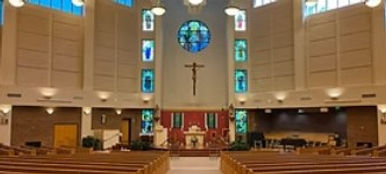

St. Gerard Majella was an 18th-century Italian lay brother of the Redemptorist order, widely known as the patron saint of expectant mothers, motherhood, unborn children, and the falsely accused. Despite a short life marked by poverty and poor health, his deep spirituality and reputation as a miracle worker spread rapidly. He became known also for his extraordinary supernatural gifts of bilocation, prophecy, ecstasies, visions, and infused knowledge. He was most successful in converting sinners and was widely known for his sanctity and charity. Today his intercession is sought by many for safe pregnancies and deliveries.

St. Kateri Tekakwitha was known for being the first Native American saint, recognized for her devout Catholic faith, life of prayer, and charity, despite facing hardship and illness. After converting to Catholicism, she became known for her piety, chastity, and devotion to prayer and fasting. In 2012, she was canonized as the first Native American saint by the Catholic Church, following a series of events and miracles attributed to her intercession. She was born around 1656 in a Mohawk village 40 miles northwest of present day Albany, New York. At age 2 she was stricken with smallpox; she survived, but the disease left her face filled with ugly scars. At age 11, Tekakwitha was visited by Jesuits. She was greatly influenced by them and was baptized and converted to Catholicism at age 19. St. Kateri died at age 24 of poor health, but witnesses reported that the facial scars she had from smallpox as a child vanished as she died; since then, numerous miraculous healings have since been attributed to her intercession.

Saint Benedict was a 5th-century Christian monk, abbot, and founder of the Western monasticism known for his spiritual leadership and the Rule of Saint Benedict. He is venerated as the Patron of Europe and is also known as a protector against poison and temptation. Born in Nursia, Italy, he became disillusioned with worldly life in Rome and sought a more solitary existence. He is the Patron of Europe, a title given to him by Pope Paul VI in 1964. He is remembered for his deep spiritual life, wisdom, and leadership, which established a new European culture after the fall of the Roman Empire. Benedict's main achievement, his Rule of Saint Benedict, contains a set of rules for his monks to follow. Benedict's Rule became one of the most influential religious rules in Western Christendom. Historians sometimes refer to the early Middle Ages as "the Benedictine centuries" because of the influence Benedict had on Western European culture and spirituality.

Born in 1891, St. Teresa Benedicta of the Cross is also known as St. Edith Stein. In 1921, while visiting friends, the Jewish born Edith Stein spent an entire night reading the autobiography of the 16th century Carmelite nun St. Teresa of Avila. “When I had finished the book,” she later recalled, “I said to myself: This is the truth.” Edith Stein was baptized into the Catholic Church in January 1922. In 1933, she entered a Carmelite convent in 1934, taking the name “Teresa Benedicta of the Cross” as a symbol of her acceptance of suffering. In August 1942 Teresa Benedicta and the members of her religious community were arrested by the Gestapo in retaliation against a protest letter by the Dutch Bishops, decrying the Nazi treatment of Jews. St. Teresa Benedicta of the Cross died in a gas chamber the concentration camp at Auschwitz a week after her arrest. John Paul II canonized her in 1998 and proclaimed her a co-patroness of Europe the next year.

Our Lady of Guadalupe is the Virgin Mary, is revered for a miraculous appearance in 1531 to a peasant named Juan Diego near today’s Mexico City, leaving her image on his poncho after he gathered roses in winter, shocking his bishop. The image remains a powerful symbol of hope and unity, with its features designed to communicate a message of solidarity to the native people. OLG is the patron saint of Mexico, the Americas, and other regions, and offers faith, hope, and protection. She is also recognized as the patroness of the unborn

St. Francis of Assisi was a 13th-century Italian friar who founded the Franciscan Order and is the patron saint of animals, nature, and Italy. While praying at the ruined church of San Damiano around 1205, Francis heard the voice of Christ speak to him from the crucifix telling him to "rebuild my church". St. Francis had many other remarkable experiences; too many to describe here, but worth a Catholic’s deeper inquiry. St. Francis founded the order known as the Franciscans, which became one of the largest religious orders. He also inspired Clare of Assisi to found the women's Order of the Poor Clares. Near the end of his life, while praying, St. Francis received the stigmata, the five wounds of Christ.
A BIG thank you to Joe Muster for the above pictures and text. Thank you Joe, for researching and sharing this information with us